The Internet As You Knew It Is Dying...
A personal timeline of the internet from the early web to an AI-shaped, increasingly automated future.
Contents
- 1995 + [The First Internet]
- 2012 + [Learning to Build for the Web]
- 2013 + [When Search Started to Change]
- 2015 + [The Polished and Artificial Web]
- 2020 + [Bots, AI, and Fake Interaction]
- 2025 + [The Internet Changes Completely]
- 2026 + [AI Becomes a Force]
- Yet here I am, building new websites and still ranking first in some of the keywords I choose. So it's not all bad.
- My Prediction
I don't feel old, but lately I catch myself sounding that way. I find myself starting sentences with, "These days..."
1995 + [The First Internet]
I was in my late teens in Hawaii when my mother turned on the computer, and there was a shopping interface on the heavy square monitor: "Prodigy." A few years later, Prodigy would mean something completely different to me: The Prodigy, one of the psychotic bands of that Gen-X era. But I still remember that strange moment when the phone line connected to this "internet" and a visual world could be found therein.
But for me, it was the beginning of the internet.
The internet wouldn't become interesting to me until I found out that you could game on it.
It wasn't until my late 20s that I actually learned how to program, code, and write valid XHTML.
2012 + [Learning to Build for the Web]
Around 2012, within the space of one year, I had learned to code and mastered SEO. I could sell my own products online. I had gotten in early enough to catch the tail end of an internet where one person could still build, rank, sell, and compete without living entirely inside somebody else's platform.
2013 + [When Search Started to Change]
2013 was when I started to notice things changing. Google had been modifying its algorithms for years, but organic search was starting to feel very different.
Soon, organically ranked content became increasingly overshadowed by paid content.
2015 + [The Polished and Artificial Web]
2015 was the year when the internet got more polished and artificial. By that time, search results increasingly felt dominated by large publishers, corporations, and platforms. YouTube was gaining huge amounts of traffic.
By 2018, internet traffic had shifted heavily toward video. Video consumed most downstream bandwidth, and Netflix alone accounted for a remarkable chunk of it.
2020 + [Bots, AI, and Fake Interaction]
By 2020, AI was starting to enter ordinary conversations as something powerful enough to destabilize industries and systems. By that time, I was no longer self-employed via the internet. Depressing times indeed. Steamrolled.
In the 2020s, we started to see more bot traffic, sock-puppet accounts, and fake interaction in massive amounts.
2025 + [The Internet Changes Completely]
By 2025, everything had changed from what it had been originally.
2026 + [AI Becomes a Force]
And I would say, based on personal observation, that 2026 is the first year AI has truly become a force to be reckoned with.
And what does this all build to?
It is an internet ruled by bots and automation, where genuine human contributions are becoming less and less a part of the experience.
It is a strange thing to have grown up alongside the internet, to have witnessed the first consumer internet enter ordinary homes, and then to watch it evolve and lose so much of its life to corporate giants, AI, and general corruption.
Yet here I am, building new websites and still ranking first in some of the keywords I choose. So it's not all bad.
The downside? AI increasingly sits on top of search results. A lot of people don't even make it down to the traditional search results anymore.
And I find myself optimizing for AI cannibalization. What is that, some may ask? That is when you hope to score a mention in AI responses, which, BTW, people often won't see or click on.
It's gotten that bad.
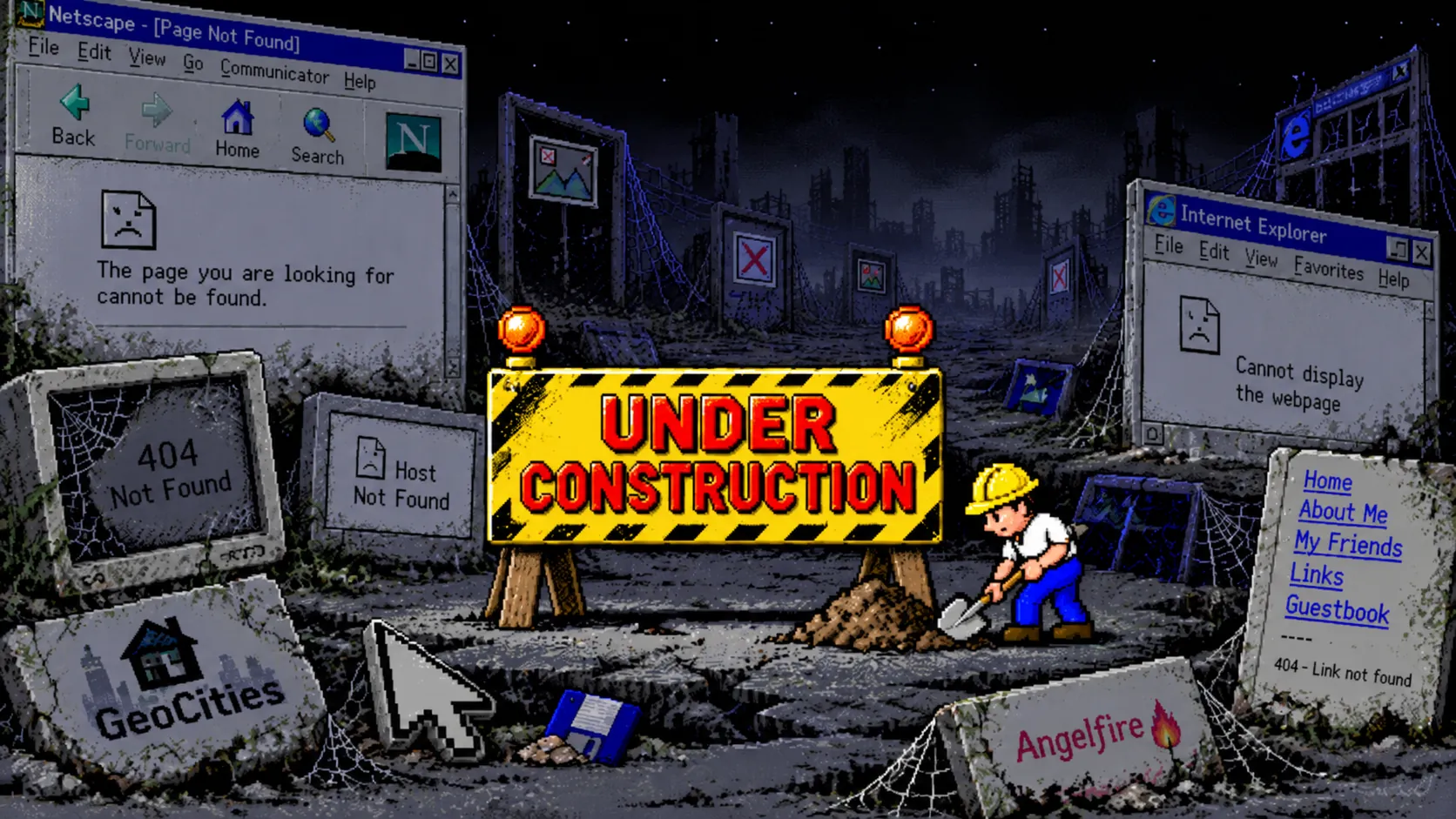
But web design is still fun. And in the spirit of those ancient GeoCities sites, I keep creating!
And, for the record, I love AI. It has taken my existing skills and amplified them.
I wrote this in NeoVim on Omarchy so nobody's going to say that AI has made me stupid.
See the article series:
Ancient Internet and Dead Internet Theory
My Prediction
AI detection algorithms are getting better, and people are becoming more averse to AI-created content.
Therefore:
Human-created content will continue to have a strong place on the internet.
- Categories: Web Design, Dead Internet, Internet
- Tags: #Internet